

How to Choose the Right Spill Kit for Your Site
- robbie jones
- Mar 23
- 3 min read

If you've ever searched for spill kits wondering which one is actually right for your site, you're not alone, there's a wide range of kits available and all to differing standards. It's one of the most common questions we get from Health & Safety Managers — and it's a great question, because getting it wrong can leave your team under-prepared when it matters most.
The good news is that choosing the right spill kit doesn't need to be complicated. In this guide, we'll walk you through everything you need to consider — so you can make a confident, informed decision.
Step 1: Know what you're dealing with
The first question to ask is: what substances are on your site? Spill kits are not one-size-fits-all or at least they shouldn't be!
There are three main types of spill kit:
• Oil-only kits — designed for hydrocarbons (oils, fuels, diesel). They repel water, making them ideal for outdoor use or near drains. They're white in colour.
• Chemical kits — suitable for a wide range of hazardous liquids including acids, solvents, and unknown substances. Typically yellow.
• Universal or General Purpose kits — ideal for general use. They absorb water-based liquids, oils, and coolants. Usually grey. A solid all-rounder for most workplaces.
Tip: If you're not sure which substances are present on your site, refer to your COSHH assessments or speak to your site supervisor before purchasing.
Step 2: Think about the size of a potential spill
Spill kits come in a range of sizes — typically measured by the volume they can absorb. (be careful here)
Rather than sizing your kit to match the largest container on site, think about what your team can realistically manage in the first few minutes of a response. The goal of a spill kit is to contain and control a spill quickly — not necessarily to absorb every last drop. For larger volumes, your emergency response plan should include additional measures such as bunding, drain covers, and multiple kits positioned strategically around the site.
A good rule of thumb is to ensure you have enough capacity to deal with a manageable working spill in your highest-risk areas — and that your team knows exactly where each kit is located.
A good rule of thumb is to size up slightly — it's always better to have more capacity than you need.
Also think about where spills are most likely to happen. High-risk areas — such as loading bays, storage areas, or near machinery — may benefit from a dedicated kit placed nearby rather than a single central kit.
Step 3: Consider your environment
Where your spill kit will be used and stored makes a big difference to which type you choose.
• Outdoors or near surface drains An oil-only kit may be your best bet to prevent hydrocarbon run-off into watercourses — which is a legal liability.
• Indoors in a warehouse or workshop A general kit is usually the most practical choice.
• Chemical storage area Always use a dedicated chemical kit - refer to data sheets to decide upon the most appropriate absorbent material.
Step 4: Check what's inside the kit
Not all spill kits are created equal and it is good practice to use COSHH assessments or risk assessments to determine your requirements - don't assume an off the shelf kit will be sufficient. A well-stocked kit may include:
Safety measures - dedicated PPE for responders
Drain protection - a temporary drain cover or blocker
Containment devices - such as absorbent booms
Absorbent materials - mats, rolls, granules or similar
Spark proof tools - where there is an ignition risk
Disposal - Waste bags and ties
Information - Inventory, instructions and advice
Watch out for kits that look well-priced but skimp on what is inside.

Step 5: Don't forget the training
Here's something that often gets overlooked: having the right spill kit is only half the battle. Your team needs to know how to use it — quickly, safely, and confidently.
Under the Environmental Permitting Regulations and the Control of Pollution Act, businesses have a legal duty to prevent and respond to spills that could cause environmental harm.
Having a spill kit on site without trained staff to use it leaves you exposed — both environmentally and legally.
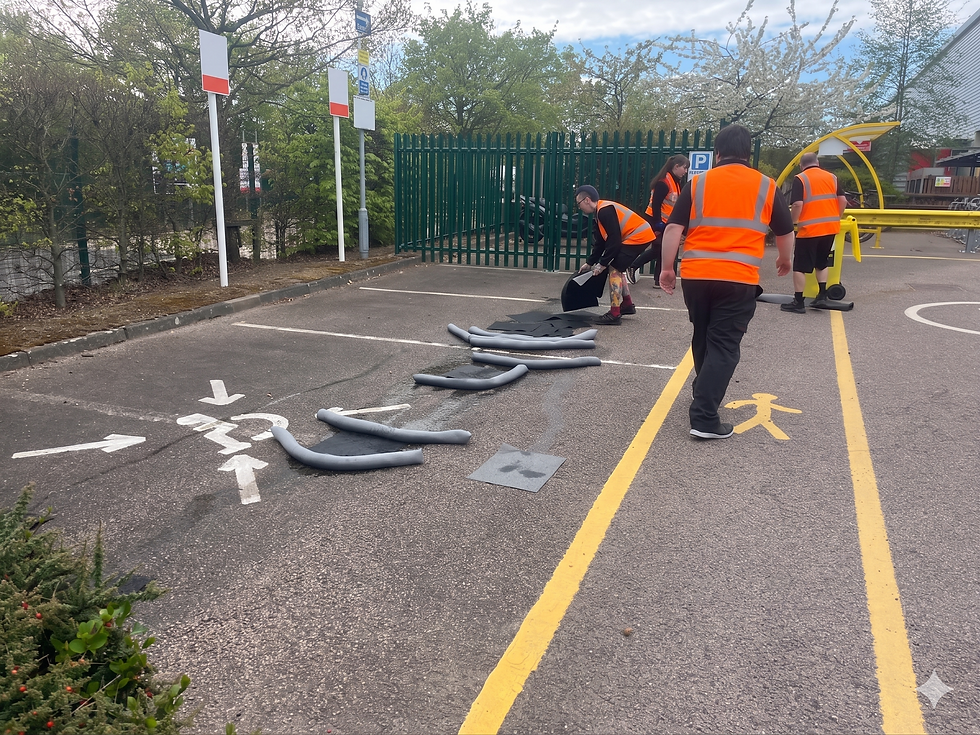
Spill response training doesn't have to be time-consuming. Our on-site courses take as little as one hour for a basic awareness session, and we come to you — so there's no disruption to your operations.
Need help getting your team trained up?
At Fluid Safe Training, we deliver practical, on-site spill response training across the UK. Whether you need a one-hour awareness session for your whole team or a full Train the Trainer programme, we'll come to your site and make sure your people are ready to respond when it counts.
Get in touch today for a no-obligation chat:
07584 302177


Comments